Wild Flowers: A Botanical Color Font for Handmade Brands
First Impressions: Fresh, Lively, and Unmistakably Organic
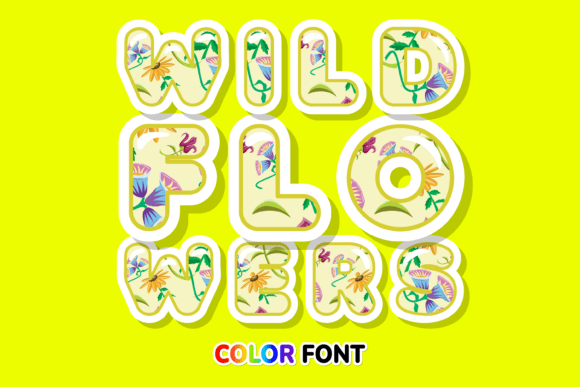
Opening Wild Flowers in Illustrator felt like unboxing a pressed wildflower journal—immediate texture, subtle variation, and a quiet sense of growth. This isn’t just another decorative font; it’s a color font that carries botanical intention in every glyph. The base letterforms are soft-edged, slightly irregular—evoking hand-painted signage or artisanal apothecary labels—not rigid vector perfection. Petal-like accents bloom from stems, leaves curl into counters, and color gradients mimic natural light on petals. It reads as joyful but not childish, whimsical but grounded. For my current client—a small-batch herbal tea brand launching a spring collection—it landed exactly where the mood board needed to go: warm, earthy, human-made.
Where Wild Flowers Earns Its Place in Real Client Work
Wild Flowers shines strongest when supporting emotional storytelling over functional clarity. I tested it across six real-use scenarios:
- Product labels & packaging design: Used at 24–36pt on kraft paper mockups, the floral overlays added tactile warmth without overwhelming the hierarchy. Paired with a clean sans serif for ingredients, it elevated shelf presence instantly.
- Social media graphics: On Instagram carousels and Pinterest pins, Wild Flowers became the hero headline—especially in vertical layouts with ample negative space. Its color richness translated well even after platform compression.
- Printable wall art & digital downloads: As part of an Etsy printable bundle (botanical affirmations + seasonal planners), Wild Flowers acted as both title treatment and decorative motif—no extra clipart needed.
- Cricut projects & sublimation design: Exported as SVG with preserved layers, it cut cleanly on vinyl and held detail in heat-transfer tests on cotton tote bags and ceramic mugs.
- Canva templates & editorial design: Integrated smoothly into branded Canva templates for bloggers and wellness coaches—its built-in color eliminates tedious manual tinting.
- Seasonal campaign visuals: For a local flower farm’s Mother’s Day promo, Wild Flowers anchored posters and email headers while feeling cohesive alongside real photography—not competing, complementing.
Design Situations That Demand Caution
Color fonts like Wild Flowers are powerful—but they’re not universal tools. In this project, I ruled it out for:
- Small-scale applications: Below 18pt, the botanical details blur, reducing legibility and introducing visual noise—unsuitable for fine print, QR code captions, or ingredient lists.
- Minimalist or corporate branding: A fintech startup or law firm would find its expressive nature tonally misaligned. Wild Flowers assumes emotional permission from the audience—and the brand voice.
- Low-contrast or complex backgrounds: On busy floral patterns or gradient overlays, the glyph colors lost definition. Always test against final background textures—not just white canvas.
- Strict typographic systems: It doesn’t pair predictably with all serif or script fonts. I found it harmonized best with airy sans serifs (like Poppins Light) or gentle handwritten companions—not bold display fonts or tight geometric typefaces.
What Designers Must Verify Before Client Deployment
As a working graphic designer, I never drop a color font into a live file without these checks:
- Test in grayscale first: Does the underlying structure hold weight? Wild Flowers retains decent rhythm without color—crucial if printing in monochrome or for accessibility fallbacks.
- Check contrast on light AND dark backgrounds: Its green-gold palette reads beautifully on cream or soft peach, but fades on charcoal unless manually adjusted via layer blending modes.
- Preview at actual usage sizes: Zoom to 100% on mockups—not just thumbnail views. I caught one glyph’s stem clipping at 20pt on a sticker die-line only after exporting.
- Validate file formats: Confirmed Wild Flowers includes OpenType-SVG and WOFF2—essential for web use—and clean, transparent PNGs for quick social posts.
- Inspect transparency & layer integrity: In the included SVG files, floral elements were grouped logically—not flattened—so I could selectively recolor stems or mute petals per layout need.
- Confirm commercial license scope: Verified the license explicitly permits use in client deliverables, print-on-demand products, and digital sales—no hidden restrictions for Etsy shops or Canva template resellers.
Why Wild Flowers Fits the Modern Handmade Business
This isn’t a font for generic “cute.” It’s a graphic design asset built for authenticity-driven brands—those where craft, seasonality, and sensory experience matter more than slick uniformity. When my tea client saw Wild Flowers anchoring their new “Lavender & Chamomile” label mockup, she said, “That looks like how it smells.” That’s the benchmark: does it deepen the emotional resonance of the product—not just decorate it?
In a landscape saturated with overused script fonts and sterile sans serifs, Wild Flowers offers a rare balance: distinctive enough to signal care and curation, yet flexible enough to scale across packaging, web banners, and printable designs. It supports—not overshadows—the handmade business narrative. For creative marketplace sellers, Cricut users building sticker bundles, or small business owners designing their own launch assets, Wild Flowers delivers ready-made botanical sophistication without requiring illustration skills.
Just remember: it’s a supporting actor, not the lead. Use it where mood matters most—on hero graphics, product mockups, seasonal campaigns, and any visual touchpoint where warmth, growth, and gentle personality strengthen your brand identity.